
Who doesn’t love a good DIY project that combines a bit of history with a touch of creativity? Let’s explore some exciting catapult design ideas that’ll not only look great in your home but also spark some joy and curiosity!
1. Combine with a Puzzle

Incorporate your catapult into a puzzle or game for an engaging family activity. It’s a fantastic way to combine learning and playtime, a favorite in my home.
2. Explore Lever Length

Experiment with different lever lengths to see how they affect your launch. Longer arms might surprise you with how far they can send your projectiles!
3. Incorporate a Marshmallow Launcher

Who says catapults have to be serious? Use them to launch marshmallows for a fun, lighthearted twist. It’s a delightful activity I often include in my family-friendly workshops.
4. The Elastic Band Arm

Replace the wooden arm with an elastic band for a unique twist. This design is all about maximizing potential energy in a fun and unexpected way.
5. The Spoon Lever

For a quick and easy build, use a plastic spoon as your launching arm. It’s a clever way to make sure your projectiles fly smoothly and is a hit with the kids at my workshops!
6. DIY Quick Release Mechanism

Integrate a simple quick release mechanism using a clothespin or hook. It adds a professional touch to your design and makes launching more efficient and exciting.
7. Rubber Band Tension

Harness the power of elasticity with rubber bands to provide the tension needed for your catapult. Adjusting the number of bands can dramatically change the distance your projectiles will travel!
8. Creative Use of Paper Clips

Paper clips can serve as pivot points or supports in your catapult. Their flexibility and strength make them a versatile addition to any design.
9. Balloon-Powered Twist

Try using a balloon for propulsion instead of traditional materials. I once saw this in a friend’s design, and it was a hit with everyone who saw it!
10. Miniature Catapult Garden Decor

Create a decorative miniature catapult for your garden using natural materials like twigs and stones. It’s a charming way to bring a bit of medieval flair to your outdoor space.
11. Colorful Duct Tape Enhancements

Decorate your catapult with colorful duct tape. Not only does it add visual appeal, but it also provides additional support to your structure.
12. Adjustable Launch Angles

Design your catapult with an adjustable component to alter the launch angle. This feature is both educational and fun, allowing you to experiment with different trajectories.
13. The Dual-Arm Design

Double the fun with a dual-arm catapult design. It’s a bit more complex but incredibly rewarding when you see both arms in action.
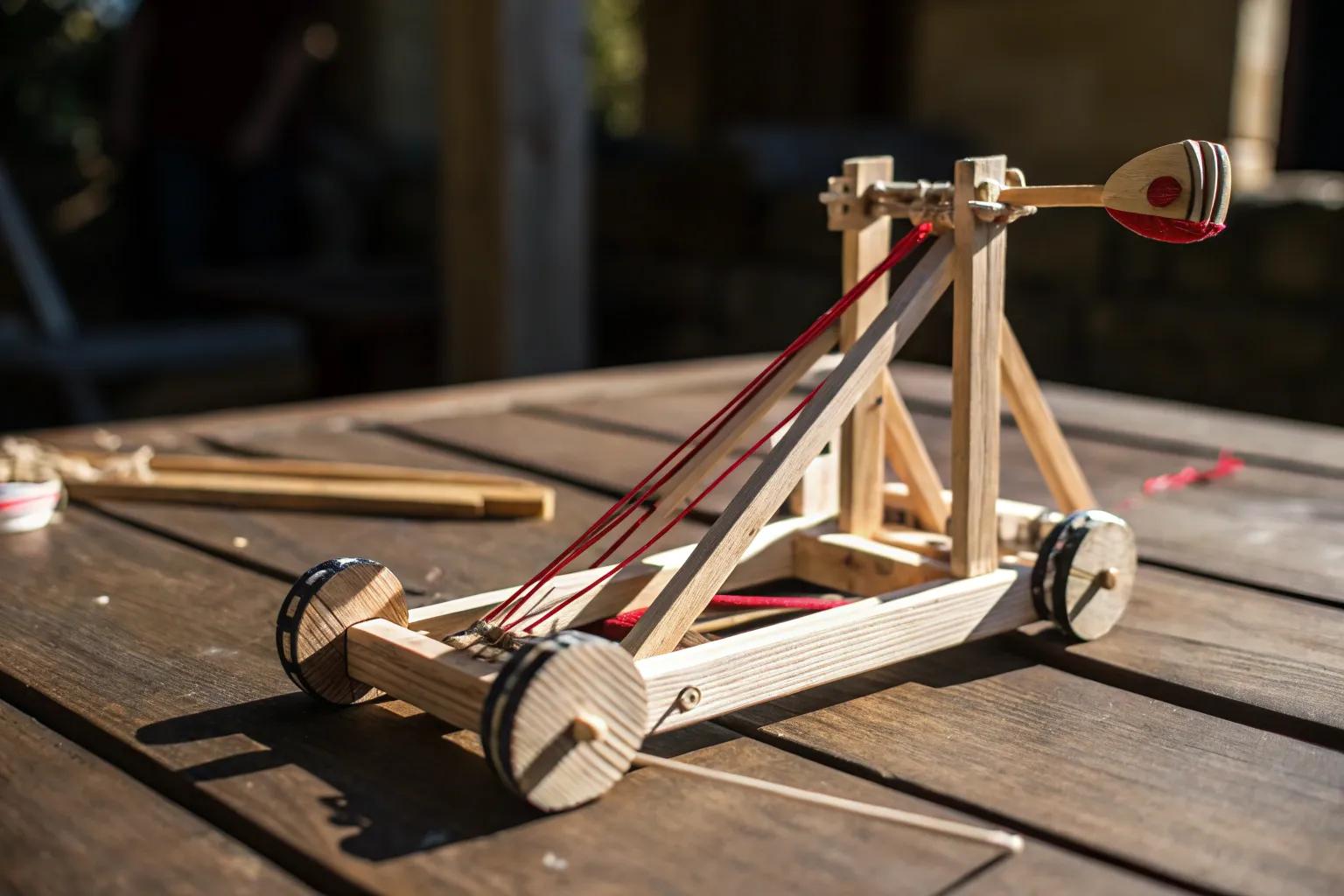
14. Integrate a Base with Wheels

Add small wheels to the base of your catapult for mobility. It’s perfect for outdoor play and adds a dynamic element to your creation.
15. Popsicle Stick Mini Catapult

Gather some popsicle sticks and rubber bands for this classic DIY project. I love how these simple materials can transform into a fun, mini catapult that’s perfect for launching small objects across the room!
16. Triangle Base Stability

Create a sturdy base using a triangular shape with wooden sticks. This design provides excellent stability and is a great starting point for understanding basic engineering principles.
17. Upcycled Tin Can Base

An upcycled tin can makes for a sturdy and quirky base. It’s a great way to incorporate eco-friendly practices into your designs while ensuring durability.
18. Use of Cardboard Tubes

Repurpose old cardboard tubes as the framework for your catapult. It’s a fun way to incorporate recycling into your project, and the tubes add a surprising amount of strength.
19. Magnetic Base for Indoor Play

Use magnets to secure your catapult to a metal surface, allowing for stable indoor play. It’s a neat trick I’ve used to keep my projects in place during demonstrations.